

All you need to know about dining in Rome like a local: meal times, how to read menus, what and how to order, how to get the check. Rome dining etiquette and dining in Rome myths to dispel!
If you’ve ever wondered what it’s really like to eat out in Rome, you’re not alone!
Many of my American readers have asked me how to navigate Roman restaurants, from ordering a meal to understanding dining etiquette, and while this request at the start seemed unusual to me, once I started digging into the reasons behind this questions, I realised this questions is more than legit!
The thing is: eating out in Rome is not that different from how you eat out anywhere else, but the web is full of misconceptions about dining in Rome, which cause a lot of overthinking and stress over something that, I promise, is a lot easier than it may seem!
If you are on the web researching a trip to Rome, you very quickly encounter ‘influencers’ sharing so called tips to eat out in Rome that are nothing but cliches and ‘rules’ that are, in most cases, simply misunderstandings of how things actually work or plain wrong.
But I can help!
I am from Rome and love eating out, so I know very well how the city works, how to pick places, what etiquette tips are important to know beforehand, also what may be different from back home and what ‘eating out in Rome rules’ are simply nonsense.
Before, I have shared all my favorite restaurants in Rome (in my where to eat in Rome section of this website) and best foods to try in Rome. Today, I take a deep dive into what to expect, etiquette and why meals in Rome are not at all the long, leisurely affair many expect!
Do I need to book all my meals ahead?
One of the most common questions I receive about dining in Rome is: do I need to book restaurants ahead? And the answer is: no, you do not need to book restaurants in Rome, unless you have your heart set on a specific one.
Rome is full of restaurants and you do not need to book if you are happy to keep things spontaneous. Like anywhere however, if you have your heart set on a specific restaurant, you are a larger group, have no flexibility on time / day or you are aiming for a social media famous open, then yes, you want to make a reservation.
Local places are most commonly booked today for tomorrow or morning for evening. Usually, reservations are by phone or email.
The more famous the restaurant is with tourists, the more the schedule is dictated by what visitors are used to back home, so often you do find you need bookings to popular places weeks ahead.
Depending on the establishment, you may be able to book online, on the phone or, very often, by whattsapp, which are also the most reliable ways to secure a table.
How Dining in Rome works– what to expect from each meal
Breakfast in Rome – la colazione
Breakfast tends to be a small meal in Rome and Italy in general, and a meal locals have at home.
Going for breakfast or brunch is not really a big thing, as we usually use lunch or dinner for social occasions, rather than a sit down breakfast; if we do meet someone in the early morning, or we need something on the go, we tend to stop at a ‘bar’ (Italian for cafe’) and have a coffee and a pastry stating up.
This coffee and pastry habit is, for locals, a second breakfast, or a treat, but since visitors don’t see what happens at home, they assume this is all there is and this is how we all eat every day, which is simply not the case.
Breakfast in Rome comes in many shapes, they are just not all available in shops as, historically, the demand for this meal outside of the house was low. But like all things, Rome has adapted!
The best ways to have a big breakfast in Rome is to get one in your hotel (hotels tend to have wonderful and rich buffet breakfast), make one for yourself in your rental, to go to a place hat offers what we call American Breakfast (pancakes, eggs etc). You can find my guide to American Breakfast in Rome here)

Let’s stop the cappuccino nonsense
I cannot talk about breakfast and eating out in Rome without addressing one of the most persisting and infuriating myths about cappuccino in Italy.
Let me set the record straight once and for all: there is NO such rule as ‘no cappuccino after 11’. This is complete nonsense: why would anyone look at the watch to serve you a drink?! It is simply a ridiculous notion.
Cappuccino is a milky drink and because of that, nutritionally, it is consumed as a breakfast drink. This does not mean we have a cutoff time for it!

It only means that locals traditionally had it more in the morning than lather in the day, nothing else. This is also something that has changed with the new coffee culture so now you’ll see absolutely everyone ordering cappuccino whenever they please.
What locals do not do is to offer cappuccino after a meal.
This is not done (all that milk after a meal is just weird to us) but it doesn’t mean you cannot do it or it is rude to ask: servers can jokingly tell you ‘no / absolutely not / you absolutely cannot do that’ but these are jokes. As long as they have not cleaned the coffee machine, in which case you don’t want to annoy them asking to use it again, ordering cappuccino after a meal simply gives you away as a tourist: which you are! And it nothing to be ashamed or worried about!
Lunch in Rome – il pranzo
In Rome, Lunch tends to happen between 1pm and 2.30 pm but in the city center restaurants have adapted to tourism all-hours meals and therefore it is common to be able to have a meal before / after those hours.
In the center, being open around the clock is not a sing of poor quality, it is just adaptation to demand, so I recommend not to dismiss a place simply because it offers lunch at 4pm: you won’t find locals eating out at that time, but this is not a sign of a tourist trap necessarily: we are just in work at that time!
In local areas, restaurants close between lunch and dinner: so, the more local you are staying, the fewer restaurant options you have out of hours. This however doesn’t mean you don’t have lunch options.
As well as full-on sit down restaurant, in Rome you have a plethora of cafes, bistros, pizza places and take out places with food options at all hours. You’ll genuinely never go hungry in Rome!
Aperitivo and Apericena
Aperitivo is the name we give to pre-dinner drinks and nibbles and a very popular activity for locals and visitors alike. After work, so after 6,30pm or so, it is common for people to go to a cafe and order a drink (alcoholic or not) and have accompanied by platters of food.
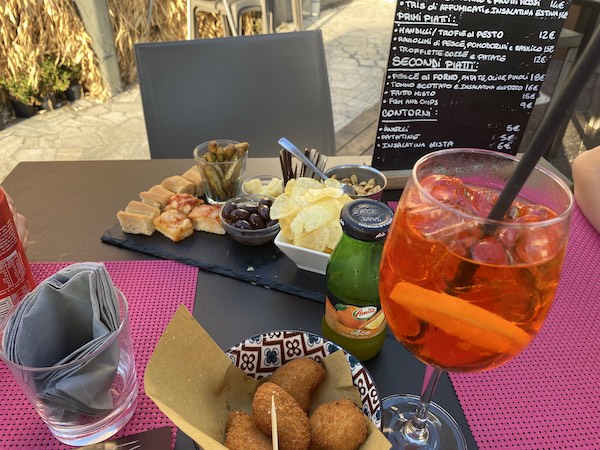
Depending on the place, food can be crisps and peanuts or you can order full on platters and make a real dinner out of it, for instance with pinsa, cheese and cured meats, chicken goujions, falafels etc, all depending on the place.
You may find this type of offering called ‘aperitivo’ or ‘apericena’ – ‘Cena’ is Italian for dinner, so apericena tends to mean a bigger food offering that can substitute dinner. You will encounter aperitivo places everywhere as you stroll around Rome, usually with black boards outside telling you offering, times of service and price.
Dinner / Supper – la cena
Dinners start at 7.30pm at the earliest but, like for lunch, restaurants in the center have adapted and you can eat also much earlier than this. The more local you go, the less this will be the case.
Types of eateries in Rome
In Rome, you have tons of different places to grab a meal.
Restaurants of course, which come is all types – casual, semi forma, very formal, with small menus, with big menus etc. restaurants can be called Ristorante, Trattoria, Osteria or many other names but they all are just what ‘restaurants’, places with tables for a sit down meal
Bars and bistros – a ‘bar’ in Italy is a cafe and they come in all shapes and sized but all have some food offering of some description. Some of them may have breakfast pastries (delivered in the morning, so they are better earlier in the day) and sandwiches, some have a much bigger offering that can also include salads and small meals, usually for lunch. These are great places for a bite on the go
Pizza al taglio – Rome is famous for a type of pizza called Pizza al Taglio, which is the local variation of pizza by the slice, except it is not by slice but by weight 🙂 Pizza al taglio is everywhere in Rome, super cheap and comes is many flavors. Usually pizza al taglio paces are take out places but often also have small tables for a quick bite

Markets – Rome has many lovely markets that can also be nice for a quick bite. Some have stalls to buy bread and meats and make your own sandwich, but many also have stalls with cooked food like cous cous salad, lasagne, parmigiana and more.
Understanding how table service works in Rome
Maybe the biggest difference between eating out in Rome and in the US is how table service works. A few important things I noticed tent to be misunderstood are:
Servers do not hover nor try make small talk. This is a huge difference between the restaurant experience in Rome and in the US. Here, servers can be nice and friendly but they do not come to your table every few minutes to make sure you are ok etc.
This is cultural and we perceive this as respectful, polite service.
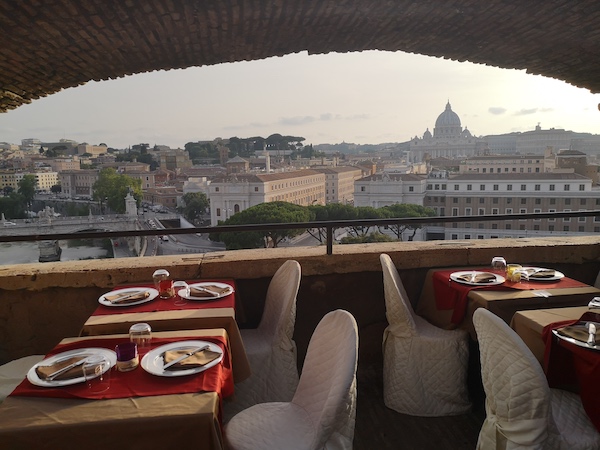
In Italy, the best service is helpful, responsive but unobtrusive, the understanding being that you are out to see the people you came with, not to have chit chat with your server. Coming to the table all the time to make sure I am ok is perceived as an interruption and intrusion and makes us feel self conscious so it is just not done.
Good waiting staff is polite, responsive and may crack jokes with you when ordering of when you are interacting with them directly, otherwise it is appropriate of them to just let you be. So please, don’t read it as rude, it is just a different approach.
Staff does not rely on tips to live. This is probably connected with the above too, but a massive difference between being waiting staff here is that here staff is always paid. All staff must have a labor contract and receive adequate pay and do not need to work extra hard or woo customers to get extra cash.
This is a very important point and one I cannot stress enough with visitors coming from tipping cultures. I completely understand that if you are used to tipping, you feel that not living a large tip is basically getting service for free, but this is not the case.
Workers here are paid and actually, giving them large sums of cash is a way to make their working conditions worse: if the employers sees that they receive a lot of cash, they can use this to lower their salary with the expectations that they’ll make it up with tips and this takes away basic labor right protection and makes income less reliable.

This is a big topic so if you want to dig more into it, I recommend you read my guide to tipping in Rome. In Rome, we do live a tip after a meal but only in the form of few euro, for instance for a 120 euro meal, we may leave about 5 to 10 euro: it’s a gesture, nothing more!
Tables are yours for as long as you like. In Rome, the check never arrives automatically: tables are yours until you request it. Simply say: “Il conto, per favore.” ‘The check, please’.
Servers won’t hover and will NOT volunteer the check, you need to ask for it.
In Rome and Italy in general, it is not up to the staff to decide when your meal is over, it is entirely down to you. Once you have finished your meal, you decide when you are read to go (within reason) and, when you are, you call the staff and ask for the check.
If you don’t know you need to ask for the check, you may literally stay at the table an hour or so, feeling neglected by the staff and thinking that ‘in Rome meals take ages’ but this is not the case at all.
You can ask for the check straight away, you can take a little longer if you are still finishing your wine, you may even take a few minutes to decide if you want a coffee or amaro or whatever.
Depending on the place, you can pay at the table or get up and go to the till to settle. In that case, you normally leave cash tip on the table (you do not give it as cash in hand)
Understanding Roman Menus
One of the most common misunderstandings about Rome food is that we only have pasta and pizza.
This is absolutely not true: in Rome, we have the same Mediterranean diet the whole of Italy is famous for and that is varied, nutrients rich and considered among the best in the world.
Sure, we have some traditional roman dishes menus will showcase as super local (carbonara, gricia etc), but we also have many more, you just need to look for them on the menu.
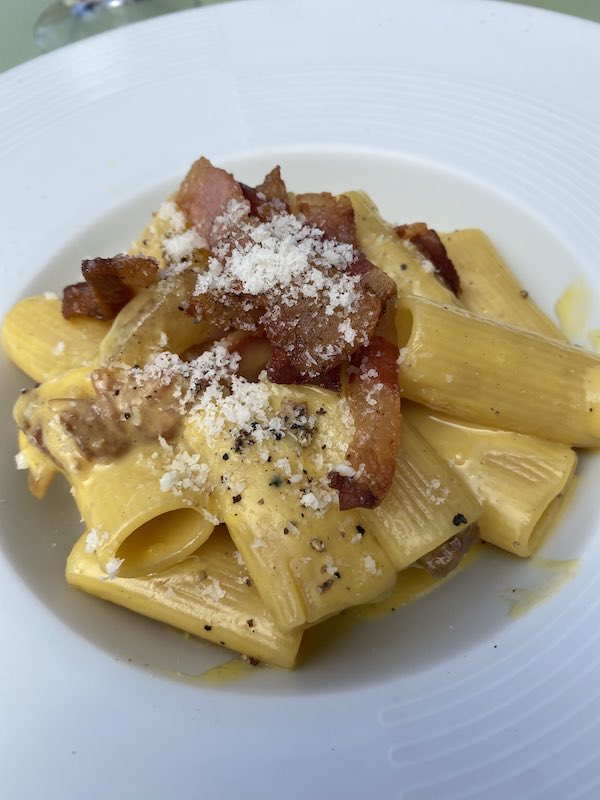
A traditional menu is usually divided into:
- Antipasti – appetizers (zucchini flowers, olive ascolane, brushette etc. Find Rome appetisers here)
- Primi – first courses, usually pasta, soup or also rice, although risotto is more common in the north of Italy
- Secondi – main dishes (meat or fish): abbacchio scottadito, pollo alla romana, baccala etc
- Contorni – sides like vegetables or potatoes
- Dolci – desserts
Good to know: each restaurants have their own dishes so you will not find the same everywhere. Aside from some staples such as carbonara, each chef has their own creations, no matter how luxurious or simple the restaurant. Because of this, there is no list of ‘Italian dishes’ to try: each menu tells you what each dish is made of and each places has its own creative interpretation of things.

Tips:
- You don’t have to order from every section. Many Romans order just a primo or a secondo + contorno and then a dessert. Different people can order different things, for instance I may order a started and a meat dish and my husband a first course and dessert: this is not a problem, they will just ask you if you want everything together or timed differently.
- Pasta is a first course, not a side. If you need a smaller portion, you can ask for ‘mezza porzione’ (half portion)
- Vegetables are usually ordered separately, not included with the main and you usually find them under ‘contorni’. If you don’t see simple vegetables on the menu, always ask: simple preparations may not make it onto the menu but they will be able to make them for you
Ordering a Meal in Rome: Step-by-Step
Ordering a meal in Rome is very similar to anywhere else, but a few pointers can be handy.
As you enter the the restaurant, you will be seated by the staff and they will ask what water you may like:
- Water: Still = acqua naturale, sparkling = acqua frizzante. Tap water is safe, but restaurants serve bottled and there is a small charge for it. This is just the way it is here. To bring your own water bottled is considered rude (although of course if you have small kids you can get them to drink their own if they need more): this is not a bring your own scenario
- Starters & sharing: Sharing antipasti is normal. Simply say, “Lo dividiamo” (we’ll share this).
- Ordering different things and share is normal but it depends on how it is done: ordering one dish to divide by 5 people in a proper restaurant is rude, ordering fewer dishes than the number of people can be normal. It is completely normal that some guests around the table order starters and some do not: they will just ask you how you prefer the food to arrive to the tables. For instance, we always ask to serve the kids’ main as the adults have a starter
- Asking for help: Servers don’t check in constantly; if you need something, politely ask.
Dining in Rome With Kids
In Rome, we don’t have separate family friendly restaurants.
In Rome and in Italy in general, we do not make a difference between places ‘for families’ and ‘other places’.
The understanding is that kids go with their parents wherever the parents go, the only limitation being common sense: you won’t bring a child to a late night bar or a disco, but that’s pretty much it.
Aside from a very limited number of places who openly market themselves as for adults only (literally, a handful and they are also often heavily criticised) you don’t need to worthy about a place not being for kids, as 99% of restaurants are open to all, even if they don’t have a child menu.
In Rome, we also don’t give separate children menus as the understanding is that kids should not be limited to a handful of flavors, but all restaurants are happy to make a simple pasta or a smaller portion for a child off menu, you just need to ask.
Most restaurants welcome children and have high chairs but even if they do not, you can usually just bring them with you. You want a sure list, these are my favorite family friendly restaurants in Rome city center.
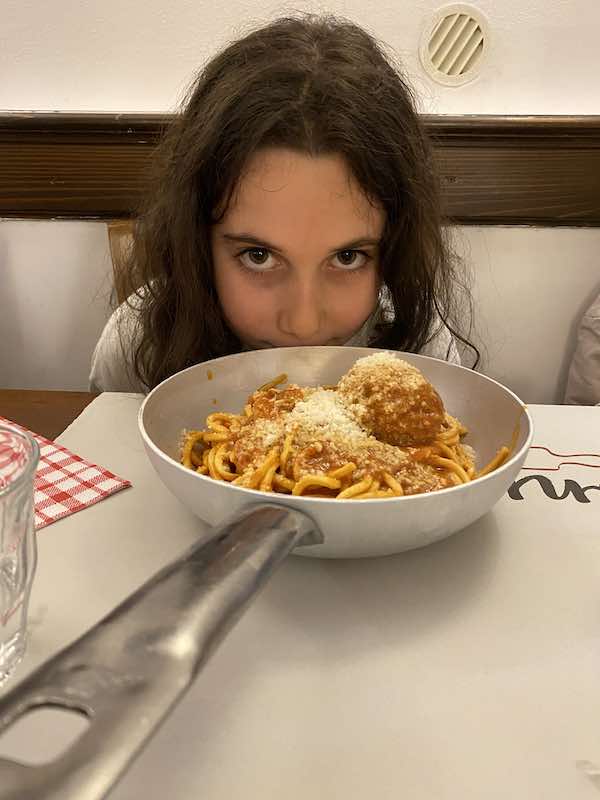
- Highchair is seggiolone in Italian and they are are often available
- Restaurants do not normally have kids menus: culturally, we do not feel kids need a more limited range of options than adults so they don’t have a separate list of dishes. However, simple dishes such as tomato pasta, or pasta with butter are always available, you just need to ask
- Strollers may be tricky in very small trattorias which is why I always say the best stroller for Rome is one you can collapse and carry easily!
You can read here >>> all you need to know about eating out in Italy with kids.
How to avoid ‘Tourist Trap’ restaurants
In the vast majority of cases, even tourist restaurants are ok in Rome, quality wise but they may come with bad surprises especially when it come to costs.
Some quick signs to watch out for:
- Menus with photos
- Staff luring you in
- “Tourist menu” signs
- Unclear pricing – pay particular attention to the cost of fish and meat: they may express it ‘by weight unit’ and not by portion, so you think you are getting something cheap but it very much not so!
- Restaurants directly facing major monuments
- Resuarant with mostly tourists – you usually recognise them for having round pizzas and spritz for lunch, two thigns locals do not order together and very much not at lunchtime (spritz is aperitivo; round pizza is traditionally for the evening as it requires a pizza oven you do not turn.
A good rule: one or two streets away from the busiest areas usually means better quality and prices.
Legit charges you may not expect
In Rome, you may encounter some charges that are different from back home and that they may feel like a scam, but are actually legal. Specifically:
You will be charged for water – for reasons I do not understand, Rome and Italy have moved onto bottled water only and this is always at a charge. This comes as a surprise to many (and locals don’t love this either) but it is the way that it is: tap water is not an option and it is not done to bring your own water either.
They may add ‘servizio’ – servizio is a service charge and can be added to your bill. It is a little like a tip and goes to the establishment, which then distributes it to the staff. If servizio is there, you must pay it: always check for it on the menu as they may state they apply it and how much clearly so you can decide before you sit down whether you are ok with it or not.
Useful Phrases for Dining in Rome
- Un tavolo per due, per favore. – A table for two, please
- Possiamo vedere il menù? – May we see the menu?
- Lo dividiamo. – We’ll share this
- Il conto, per favore. – The check, please
- Senza glutine – Gluten-free
- Com’è preparato questo piatto? – How is this dish prepared?
Eating out in Rome with allergies and food intolerances: useful tips
Eating out with intolerances or full allergies can be stressful but Rome is reasonably well equipped for it. By law, all menus MUST list common allergens and there is a good understand of what intolerances and allergies are and how serious they can be.
Menus have allergens marked in different ways: some are very clear (little drawing of shellfish for instance or gluten), others have a list of numbers and keys to know what is in each dish.
My tip; always read the menu but also always bring a card with you in Italian and English stating your allergy and what you cannot eat. You don’t need anything fancy, just a clear message printed out saying what you absolutely must avoid – this will equip them with all they need to know and make sure they can indeed serve you safely.

Good to know: I noticed that while lactose intolerance is well understood, wider dairy allergy / intolerance is understood less. So in this specific case especially I’d be extra conscious to be VERY clear about what must be avoided.
I hope these tips help and made ordering a meal and dining in Rome becomes easier. Safe travels!
