

Discover Rome’s Christmas traditions and learn how Romans celebrate Christmas with this guide by a local (me!): nativity scenes, Christmas Eve customs, festive foods and local rituals you need to know about.
Christmas in Rome is more than lights, markets and decorated trees.
It is a season full of emotion, family traditions and moments that Romans look forward to all year: some are similar those you find in other countries (the trees, the gift giving), some unique to the city.
If you’re visiting from abroad, you’ll have the chance to experience some of them and today, I thought it could be fun and helpful to help you understand what is happening in Rome during the Christmas season and why. I belief this will make your experience significantly nicer and authentic!
I am from Rome and I love Christmas: no matter my age or the age of my kids, I very much celebrate with all the trimmings – the tree, the Christmas market visit, the Christmas eve meal… this is all you need to know about Rome Christmas traditions, based on my very own local Christmas experience of my beautiful hometown!
Let’s step inside a Roman Christmas!
8 December: The Season Begins! Why and How Christmas in Rome starts on this day
Christmas season in Rome officially starts on 8 December, the Feast of the Immaculate Conception (Immacolata Concezione).
This feast has its roots in the Catholic dogma according to which the Virgin Mary was born free of the original sin and is it therefore quintessentially Papal in origin (doesn’t get much more Roman than this!); however, it is a National Holiday so everyone has a day off and enjoys the vacation, no matter their background.
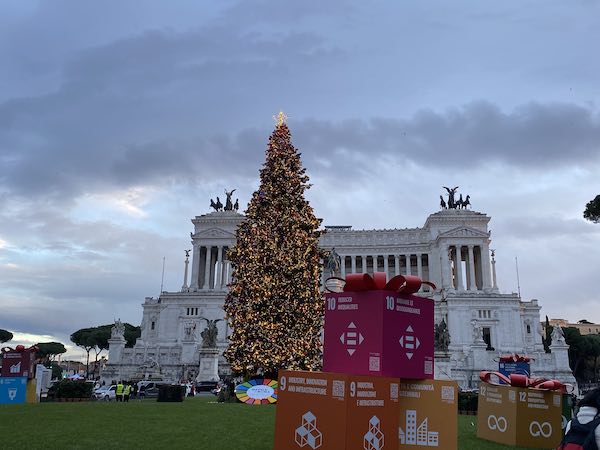
The 8th of December is also the day when the festive season begins in Rome. On this day, families traditionally put up the Christmas tree and the big ones in the squares and public areas get lit up (sometimes, this can happen the weekend before too, the actual logistics may vary depending on the year).
While you have some decorations before the 8th, only now Christmas has truly begun!
Good to know! In Rome, Christmas is a A Season, Not a Day. Many of my US friends tell me that, in the US, Christmas ends on 25 December. In Rome (and Italy) it doesn’t! It it continues until 6 January, the day of the Epiphany, when the Three Kings arrived to baby Jesus and when Befana arrives with sweets and small gifts for kids! You can read all about the Epiphany in Rome here.
So if you’re visiting during this stretch, remember this is very very high season for tourism as all Italians are off and traveling: do not be surprises if Rome is bursting at the seams with crowds at this time.
The importance of Christmas Eve
If you notice that Rome seems strangely quiet on the evening of December 24th, there’s a reason: Christmas Eve (La Vigilia) one of the emotional cores of Italian Christmas and, for many, the most meaningful moment of all.
Christmas Eve is a deeply family-oriented evening. Most Romans spend it at home with parents, grandparents, siblings, cousins and it is a massive affair: people dress up, there are Christmas trees, lovely Christmas appetizers, generous mains, a abundance of wine, Prosecco (to toast at midnight) and there is also gift giving, although there are variations from family to family.

For instance in my family, Christmas Eve is a ‘small gift to the kids in anticipation to the big one on Christmas Day’ occasions, while some of my friends have the full Christmas gift exchanging happening at midnight of the 24th.
Traditionally, the dinner is a fish-based meal and this is rooted in the Catholic custom of avoiding meat on the eve of major religious feasts.
Good to know! This is NOT the 7 fish dinner you find in the US! That is an Italian American tradition with origins that only partially overlap with ours so don’t be surprised if you are invites to a Rome Christmas Eve to a local’s house and notice the tradition to be rather different!
It’s a long, slow dinner full of warmth, conversation, and dishes that only appear this one night a year. If you are interested, you can find here >> a list and ideas for Italian Christmas Eve dinner.
After dinner, families play cards (mercante in fiera is traditional), tombola (bingo), unwrap small gifts.
This is also the night of Midnight Mass, a moment of deep significance for many Romans, whether practicing or cultural Catholics.
The important corollary to this is: many restaurants close because no one wants to be anywhere but around their family table so if you want to eat out this evening, search one that is open near you and book. Try pick one that is walking distance from your accommodation so you don’t need to stress over securing a taxi (there won’t be many)
If you’re out late, you’ll notice the streets aren’t lively: Rome is busy celebrating indoors.
At Midnight, it is common to cheer with Prosecco and, some families, also add the figurine of baby Jesus to the manger as midnight strikes (see below)
Christmas Day in Rome
Christmas Day (Natale) is the other center of Rome Christmas traditions and centres around a long family lunch.
If you walk through the city in the morning, you’ll hear church bells, see families heading to Mass, and feel a serene, peaceful atmosphere. The only people out and about this morning are tourists (lots of them, if you want to escape crowds, go out very early)!

Christmas lunch is where Roman food traditions shine:
- Selections of starters
- Lasagna or baked pasta
- Roast — traditional main
- Salads of all sorts — crisp and seasonal
- Panettone or Pandoro — Italy’s two iconic holiday cakes
All these and more appears on Rome Christmas tables, along with coffee, digestives etc.
26 December: Santo Stefano, the “Second Christmas Day”
The day after Christmas is also a public holiday in Italy.
Il giorno di Santo Stefano is another day for family gatherings, walks, leftovers, and visits to relatives although it is also common to see friends: Christmas is for relative, St Stephen’s Day has wider scope.
If you see crowds in the afternoon, that’s Romans enjoying this extra festive day together.
The Cultural Importance of Nativity Scenes (Presepi)
Traditional, the heart of an Italian Christmas is not the Christmas tree but the presepe, the nativity scene.
They appear in:
- churches
- shop windows
- small neighbourhood squares
- large public displays
- homes, and each family has their own tradition: some scenes are small and intimate, some are super elaborate and real works of art with figurines passed down from generation to generation!
As I mentioned above, many families leave the manger empty and add baby Jesus at midnight.

Romans often go from church to church admiring different nativity scenes, each with its own artistic style and story and it is a worthy thing to do in Rome at Christmas with kids too, as the scenes area meaningful and easy for them to enjoy.
The one in the photo is Sant’Eustachio but the biggest one of all is in St Peter’s Square, of course!
Christmas Trees: Where They Are and Why They Matter (A Bit Less Than You Think)
Rome does have beautiful Christmas trees and the most famous ones are in:
- St Peter’s Square
- Piazza Venezia (usually, although with the digging going on this year, it all looks very different!)
- Piazza del Popolo
- Spanish Steps or Piazza di Spagna
We also have trees in homes however, do not be surprised if they are smaller and less elaborate than you imagine: we do not go all out like you see in the Hallmark movies! The biggest tree and the most impressive one is in Piazza San Pietro at the Vatican.

Why Piazza Navona Has a Christmas Market (and What It Symbolizes)
Rome doesn’t have large “German-style” Christmas markets, but Piazza Navona’s market has a special cultural meaning.
For decades, Romans brought their children here in December to ride the carousel, buy small toys, and enjoy festive sweets.

The market changes in size and quality each year, but the sentimental value is enormous. For many locals, it represents childhood Christmas magic — the smell of roasted chestnuts, colourful stalls, balloons… I used to always of with my mom on the 6th of December and still now I make sure I at least pass by!
Even if it’s not the shopping destination of Europe, it’s a wonderful window into Roman holiday nostalgia and one of the most locally rooted Rome Christmas traditions of all!
The two speeds of Rome at Christmas
During the Christmas season, you’ll see that Rome has two different velocities.
Local Rome slows down. Not in a “closed and inconvenient” way — but in a way that reflects the rhythm of family life.
You’ll notice:
- fewer cars on the road
- many offices and schools closed
- families together enjoying the city
- a sense of unhurried, contented holiday mood
Tourist Rome is, on the other hand, as fast and busy as it gets! The whole world comes to Rome at Christmas so anything that is geared towards tourism is busy, hurried and overflowing. The more you can tap into the local rhythm, the more you’ll enjoy this time: Christmas in Rome is the worst time for fast tourism, you really want to slow it down as much as possible!
Festive Foods with Cultural Meaning
Behind every Christmas food, there’s a story.
Panettone & Pandoro
neither Pandoro nor Panettone are originally from Rome but they are everywhere and a quintessential part of Rome Christmas traditions.

These cakes aren’t just desserts, they’re holiday gifts. Romans buy them for friends, teachers, coworkers… everyone. During December, you’ll see people on buses carrying beautifully wrapped cake boxes — they’re on their way to deliver seasonal “auguri” (Do you know how to say Merry Christmas in italian?). We do not bake these! We buy them.
Mandarins and walnuts
The smell of mandarins is a universal Roman childhood memory of Christmas. They appear in every home.
Torrone (Italian nougat)
A classic family sweet: soft nougat for the kids, hard nougat for the adults.
Fish on Christmas Eve
A cultural echo of religious tradition: a “lean” meal to prepare spiritually for the celebration of the next day.
Lentils (New Year’s Eve)
Not Christmas-specific, but part of the holiday season. Lentils symbolize good luck and prosperity.
How to Blend In: Cultural Tips for Visitors
If you’d like to experience Christmas like a Roman, here are small, respectful gestures locals will appreciate:
- Say “Buon Natale!” freely — Italians love exchanging warm greetings
- Attend a local parish Mass, for a deep dive into local Rome religious traditions
- Take a Christmas afternoon walk to see the lights in the centre and the Piazza Navona Christmas Market
- Consider having a Christmas Eve dinner in the house, with local foods (a lot can be purchased, you do not need to crazy cook while on vacation)
- Try panettone and pandoro and join the debate about which one is nicer (families fight over this, we take it seriously!)
- Watch for nativity scenes inside churches
These simple acts help you experience Rome not just as a visitor, but as someone sharing in the cultural heartbeat of the city.
I hope you enjoyed this overview of Christmas traditions in Rome and helps you make the most of your stay even more! Buon Natale!
Rome Christmas traditions: pin this!
