
All you need to know about the Barberini Mithraeum: how to visit and interesting facts about Mithraism in ancient Rome.
The Barberini Mithraeum is an ancient underground temple to the God Mithras, under the grounds of Palazzo Barberini, in Rome.
The Mithraeum dates from the III century AD and has a fantastic and well-preserved fresco of the God Mithras, one of the most beautiful you can see in Rome.

The Mithraeum has only recently opened to the public: you can visit by guided tour (Italian only) on selected dates (find info at the end of this page).
The Barberini Mithraeum is a small yet significant underground site in Rome and a must-see for ancient history lovers and anyone looking for a more hidden side of Rome.
In this guide, I share all you need to know to visit the Barberini Mithraeum and essential and fascinating facts about Mithraism in Rome.
What is the Barberini Mithraeum, and why you should visit
The Barberini Mithraeum is a III century AD underground temple to the God Mithras, an ancient Roman God popular in imperial times.
It is a rather ample underground space with an aperture on the ceiling to allow a small amount of natural light.
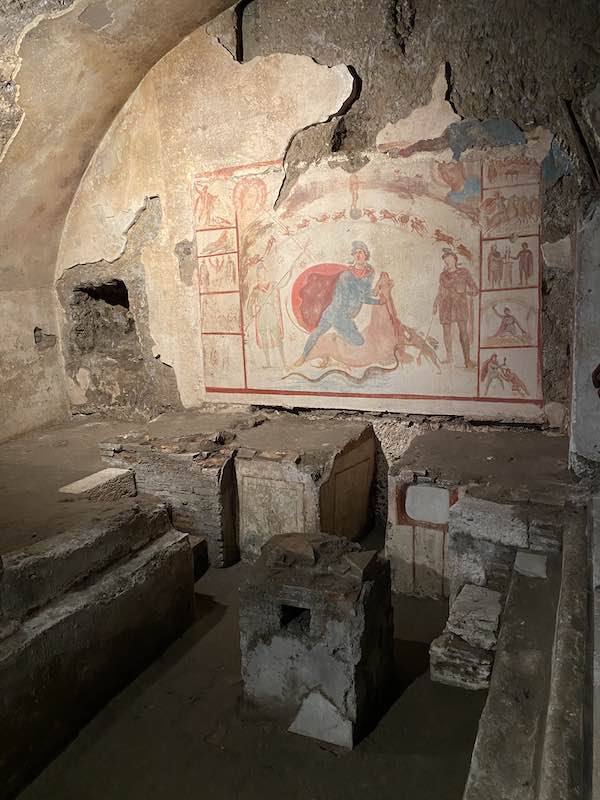
It has an altar and a spectacular fresco representing the God Mithra in the act of killing a bull (Taurobolio or Tauroctony).
The Mithraeum was discovered by chance during the restructuring work of part of Palazzo Barberini in 1936, and only opened to the public in November 2021.
The temple is a wonderful attraction suitable for people with a specific interest in ancient religion and art. I am a Roman history graduate and loved it.
However, it is a rather specialised site and while it is possible to admire it even without historical background, I believe it may be underwhelming for some.
I highly recommend visiting if you love ancient history, religion or you are looking for something different to see in Rome.
What we know about Mithra and his cult
The Mithraeum is beautiful and an important site to learn and understand about the cult of Mithras.
Mithras was a God of Eastern origin whose cult became popular in Rome in imperial times. The cult was prevalent among the roman legionaries and was a mystery religion.
The mystery nature of this religion explains why Mithras was worshiped underground and why we do not have many written accounts of what it entailed.
Despite the difficulties relating to studying a secretive religion, there are some elements historians have been able to reconstruct.
Mithras was a God of eastern origin who came to Rome from the Indo-Iranian area and cultures.
His myth says he was born from a rock and came to the world with a knife and a fiery torch.
He was a solar god and the keeper of pacts. He is usually represented as a young man with a Phrygian hat and a mantel, usually in the act of killing a bull with a tail ending in a spade of grain.
The scene is usually completed by the presence of a scorpion, a snake and two figures bearing a torch each, one lit and carried high and one unlit and pointing to the ground.
Mithra was worshipped underground, in dedicated rooms called Mithraea.
The cult was for initiated people only, and it seemed to have foreseen seven levels of initiation: Corax, the Crow, Cryphius or Nymphius, the Occult or the Groom, Miles, the soldier, Leo, the Lion, Perses, the Persian/ Perseus, Heliodromus, the sun messenger and Pater, the father.
The religious ceremony took the form of a ritual banquet to which only the highest members of the religion could take part, the others acting as servants.
What do you see in the Barberini Mithraeum?
What we see of the Barberini Mithraeum now is the central part of the temple, where the banquet would have taken place.
On the back wall, you can see the large fresco with Mithra killing the bull and, in the room, it is possible to still identify the main altar, the fountain for water and the mensae, the tables where the food would have been served.
The visit only takes a few minutes, and the most interesting element is the explanation of the fresco.
The act of killing the bull (Tauroctonia) was typical of the ancient world and had many examples in ancient Cretan and eastern representations.
However, the Mithraic representation of it has some specificities.
First of all, Mithra is always dressed in a Phrygian hat, which connects him with his geographical origins/
he also has a cape with seven stars, which are at the same time a representation of the universe and the seven grades of initiation of his religion.
The bull has a tail ending in a spade of grain to represent the cycle of life and life after death.
A scorpion pinches the testicles of the bulls in an apotropaic gesture, and a snake is also usually present under the animal.
The two carriers of fire are usually interpreted as the beginning and the end of the solar path in the sky, morning to evening.
Other representations accompany the main act, showing Mithras and the Sun and different moments in the life of the god.
The scene of Mithra killing the bull has been interpreted for a long time as a representation of Mithra’s myth, a way to bring to life a mythological episode of the killing of the bull.
However, a new interpretation is now dominant: we owe it to David Ulansey, scholar and author of the study: The Origins of the Mithraic Mysteries.
In his now widely accepted interpretation, the representation is not of the myth but of a specific presentation of the night sky at a precise moment in time.
According to this interpretation, Mithra is the constellation of Perseus that moved to take the place of that of the bull. Scorpio presents itself in the Lowe right quadrant of the sky and hydra (the snake) further to the left.
According to this interpretation, the fresco would be the equivalent of a snapshot of a significant astronomical event: this makes sense if read in conjunction with the discovery of the precession of the equinoxes, also identified at that time.
How to visit the Barberini Mithraeum
The Barberini Mithraeum is under Palazzo Barberini and precisely under Palazzina Savorgnan di Brazzà, at the back of the estate.
Address: Via delle Quattro Fontane 14
Booking is compulsory; you can get tickets here.
Location: the Barberini Mithraeum is at the very end of the front yard of Palazzo Barberini.
Buses serving the area are 53, 61, 62, 63, 80, 81, 83, 160, 492, 590. The closest metro station is stop Barberini, Metro line A
As you enter the main gate, you need to walk under the arcade and walk up to the end of the garden where you find another entrance. The Mithraeum is behind that.
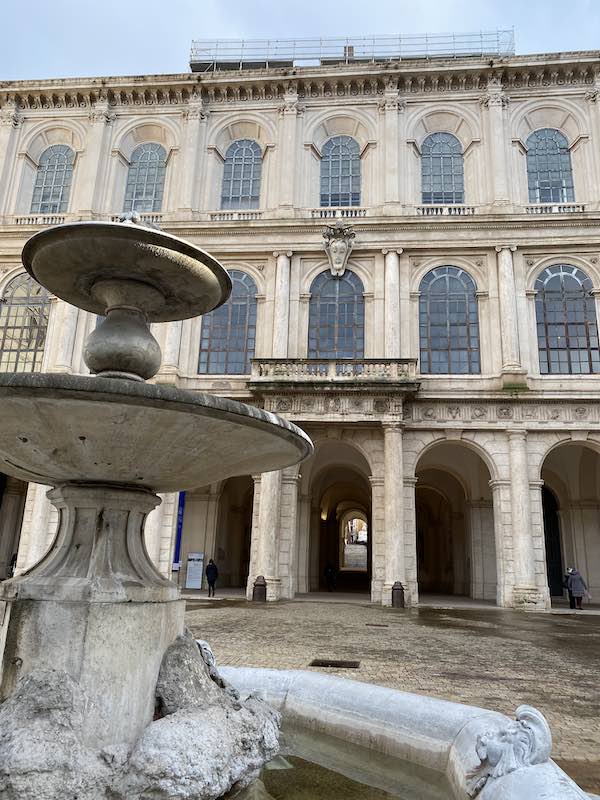
Guides usually wait at the main gate, the fountain or at the Mithraeum itself – they are not always easy to identify, so arriving a little early is mandatory.
The Mithraeum is a flight of steps underground. There is no accessible path to it.
Visiting Mitreo Barberini Mithraeum with kids
The Barberini Mithraeum is suited to older kids who may find the history of the place fascinating. The Mithreum is not stroller accessible and there is no space for small kids to run around or touch anything.
If visiting with a toddler, I recommend to divide and conquer: outside the Mithraeum, there is the nice front yard of the Palazzo. I recommend one adult waits for the child there while the other goes in.
Due to current restrictions, only five people at the time can enter the Mithraeum so even large groups get divided up and enter in turns.
What to see nearby
Palazzo Barberini is in Rome City center, in the Trevi District, close to many attractions and points of interests.
Things you can see near Barberini Mithraeum are:
Piazza Barberini – one of the most famous piazzas in Rome, this square has two important fountains, including the Fountain of the Triton, famous Rome fountain by Bernini.
Santa Maria della Vittoria – stunning baroque church with Bernini’s Masterpiece ‘The Ecstasis of St Therese’
San Carlino alle Quattro Fontane – beautiful baroque church by Borromini
Sant’Andrea al Quirinale – chruch by Bernini, who considered it one of its own most successful achievements
Piazza del Quirinale – stunning piazza on top of Quirinal Hill, with a belvedere, the Quirinale Palace and an obelisk
The Trevi Fountain – quintessential Rome icon
Trinita’ dei Monti – the top of the Spanish Steps
I hope you enjoyed this quick overview of the Barberini Mithraeum and it helped you plan your visit. Safe travel planning!