
A list of the most important and beautiful archaeological sites in Rome, Italy. From archaeological digs in Rome to unmissable historical landmarks, these are Rome must see for history lovers. [2026 Update]
Rome is famous for its history that spans millennia and beautiful archaeological sites.
The city is a treasure trove for history lovers and curious souls but what are Rome’s archaeological sites? Where should you go to see ancient Rome and what are the city’s most famous historical attractions?
As well as proud Roman, I have a university degree in classic and ancient Rome so today, I am sharing my list of archaeological sites in Rome you should not miss.
When relevant, I added a link to ticket providers I trust, so you can start giving shape to your Rome itinerary!
Please note: this post contains affiliate links and, should you make a purchase through them, we might make a small commission.

Unmissable archaeological sites in Rome – chart
| Name and info / booking link | Type | Ticketed |
| Parco Colosseo (Colosseum, Romand Forum, Palatine Hill) | Open Air Archaeological Park | Yes |
| Caracalla’s Baths | Open Air Archaeological Park | Yes |
| Largo Argentina Sacred Area | Open Air Archaeological Park | Yes |
| The Appian Way | Open Air Archaeological Park | |
| Nero’s Domus Aurea | Underground archaeological site | Yes |
| Circus Maximus | Open air chariot stadium | No/Yes |
| Ostia Antica | Open Air Archaeological Park | Yes |
| Trajan’s Markets | Open Air Archaeological Park and Museum | Yes |
| Roman Domus at Palazzo Valentini | Ancient Roman House | Yes |
| Crypta Balbi | Roman crypt | Yes |
| Vatican Necropolis | Archaeological dig | Yes |
| Ara Pacis and Augustus’ Mausoleum | Ancient Roman Altar and tomb | Yes |
| Portico d’Ottavia, Marcellus’ theater, Forum Borium | Ancient Roman market and theater | No |
| Vicus Caprarius | Ancient Roman houses and aqueduct (underground) | Yes |
| San Clemente | Church with Roman underground layer | No |
Map of the most famous archaeological sites in Rome
Archaeological sites in Rome list + tips for visiting
Colosseum, Roman Forum, Palatine Hill (Parco Colosseo)
The most famous historical site in Rome is the archaeological park with the Colosseum, the Roman Forum and the Palatine Hill, an area now called Parco Colosseo (Colosseum Park)
Parco Colosseo is a large archaeological area with the bulk of ancient Rome and is an archaeological wonder. Here, you can see where Rome began (the Palatine), stroll around the Forum and of see the Colosseum, basically experiencing several moments of Rome’s history all in one place.
Many visitors see the Colosseum and skip the Roman Forum and Palatine, but if you love history or are even just moderately curious about it, I cannot stress enough how worth entering the Forum and Palatine area is!
The area is just stunning: the Palatine is where Rome was born and visually glorious: it looks like a garden, it has amazing viewpoints over the ancient and the modern city, and iy has large, outstanding ruins of the imperial palaces.
Even just a stroll here for visual pleasure is worth it!

The Roman Forum is where you find yourself walking around ancient Rome and is where you find outstanding temples, the House of the Vestals and the tomb of Caesar, among other things. The Forum is where you truly immerse yourself in Ancient Rome.

The Colosseum needs no introduction and it is the landmark that gives the name of the overall park. The Colosseum is physically beside the Forum and you can easily visit them on the same day, especially since most tickets is include both.

My recommended way to visit Parco Colosseo is with a guided tour as, especially the Forum and Palatine, are not easy to ‘decipher’ without insider knowledge. My favorite tour is this one (it’s with an accredited Colosseum partner, which is not to be underestimated as no all operators are!)
How to visit: Find my tips for visiting the Colosseum here | Find my tips for visiting the Roman Forum here | Find my guide to the Palatine Hill here
Address: Piazza del Colosseo 1, 00184 Rome
Caracalla’s Baths – Terme di Caracalla
The baths of Caracalla are the remnants of the huge thermal complex built by Emperor Caracalla in the III century and one of the most visually stunning archaeological sites in Rome of all.

They are a vast, open air archaeology sites and despite being jaw droopingly beautiful, it is often overlooked by mass tourism, which means it is blessedly calm and quiet pretty much all the time!
Caracalla’s baths is an outdoor archaeological park and you walk on ancient pavements and mosaics however, the terrain is flatter than the one of the forum and the site is easier to access. Good info panels are available throughout and you do not need a guided tour to understand what you are seeing.
How to visit: find my full guide to visiting Caracalla’s Baths here | Find tickets here
Address: Viale delle Terme di Caracalla, 00153 Rome
Domus Aurea – Nero’s imperial Palace
The Domus Aurea is the lavishly decorated palace Emperor Nero built as his residence in Rome in the I century AD.
Described by historians of the time as the biggest and most luxurious house ever built in Rome, the house was vast and occupied an area that spanned from the Palatine Hill to the Esquiline Hill, occupying a total of over 50 hectares. However, you are not entering a luxury home here!
The Domus Area included residential areas, entertainment spaces, gardens and a lake, but its history took a very peculiar turn so now the house is entirely underground!

As you visit it now, you find yourself in a palace that is completely below street level: as you walk around it, you find yourself in massive corridors, rooms that are partially still wonderful decorated, but none of them looks out anymore so you are truly in an archaeological dig!
The place is stunning in its current state but tours now offer the option to also see how it was with the aid of a VR set and genuinely: it is special! Really worth seeing!
You can read my review and find all the info about visiting the Domus Aurea here. | Find tickets here.
Address: Via della Domus Aurea, 1, 00184 Roma
The Ancien Appian Way
The Appian Way is one of the most ancient roads in Rome and now an open-air archaeological park and UNESCO World Heritage Site. The road dates form the IV century BC and connected Rome to Brindisi, all the way South in Puglia, and it is significant historically and for visitors because it is lined with Roman funerary monuments and mausoleums: the Tomb of Cecilia Metella, Villa dei Quintili, the Circus of Maxentius, nearby aqueducts, and underground catacombs are all here.
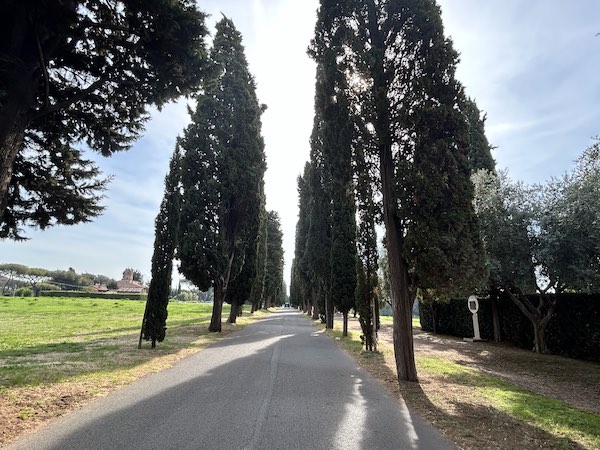
The Appian Way Park is different from other archaological sites in the city as it is stretched along the ancient road so it has no entry ticket but also requires transport as the road is so long! The most pleasant way to visit is by bike (the ancient road is not car accessible; if you cannot cycle, you can however reach the catacombs area by car). If you can cycle, a guided tour by e-bike is the best way to cover good a good amount of ground, reach the most significant monuments and know what you are looking at! My favorite tour is this one.
Ancient Ostia – Ostia Antica
Ostia Antica is the ancient port of Rome and is outside of the city center yet still within the boundaries of Rome city.

Nowadays the city is an archaeological Park and it is stunning: often compared with Pompeii, in Ostia Antica you can see a wonderful theater, incredibly well-preserved remains of houses and shops and stunning mosaics.
The park is outdoors and it is the best place in Rome to experience how an ancient city would have looked and felt like: unlike the Roman Forum, which leads you among the ruins of what would have been official buildings, in Ostia Antica you walk on streets framed with shops and private homes, an experience only truly comparable to that of visiting Pompeii or Ercolaneum.
How to visit: find my guide to Ostia Antica here | Get Ostia Antica entry tickets here
The Sacred Area of Largo Argentina
The Sacred area of Largo Argentina has only been recently reopened to the public and is an incredible archaeological spot in Rome on several accounts.
This is the place where Julius Caesar was killed (and where re-enacting of that even take place at the Ides of March) but it is also one of the most significant areas in Rome where to see remains from Republican times. It is also a place known for its cats, so if you love archaeology and cats, this is not to be missed 🙂

Trajan’s markets – Mercati di Traiano
Trajan’s markets are an imposing archaeological site encompassing the forum by emperor Trajan and a wonderful museum about his conquests.
The markets are in front of the area of the forum most commonly visited and they are very different from other roman ruins as you have both an open air part of it but also an interesting museum path, with a lot of info panels and interesting items to see, with informative info panels that allow for a meaningful visit even without a guide.
As you enter, you have a beautiful museum explaining the significance of Trajan’s empire in the history of Rome and Europe and then you get the chance to walk on well-preserved streets and appreciate also how the city changes as history moved from the height of the empire to the middle ages.
You can get a sense of how beautiful these markets are by taking a free virtual tour from home. Find it here.
Address: Via Quattro Novembre, 94, 00187 Rome

Roman Domus at Palazzo Valentini – Domus Romane di Palazzo Valentini
Palazzo Valentini is unique in Rome as it offers the chance to visit an ancient roman house right in the center of the city.
Many of Rome’s ancient ruins bring your attention to temples and official buildings but palazzo Valentini allows a view of a much more intimate aspect of ancient life as allows you into a private home.
To access, you follow steps that go underground to below street level. Here you enter the toman house and light and voice show projects on the wall what the decor would have been like.
Need to know! To allow you to see all aspects of the dig, you walk on transparent plexiglass that can be unsettling if you are afraid of heights (you are a couple of meters or more above ground level).
The visit to this Roman Domus also includes a special showing of a documentary about Trajan’s Column, which you can see right in front of the Domus and can admire from one of the windows.
This is not to be missed: the reconstruction of the column, the chance of seeing it as it would have looked when built and the peculiar setting of the showing make this an exceptional and uniquely Roman experience. Find tickets and photos here (photography is not allowed inside).
Address: Foro Traiano, 85, 00186 Rome
Crypta Balbi – Cripta Balbi
Rome has been inhabited for millennia, the new city built literally above the ancient one. This series of layers of history are seen best in Cripta Balbi, the best place in Rome to see how different times reused spaces and interacted with the builds and materials of the centuries before.
The crypt was originally part of a theater but, over time, was used as a burial ground, a kiln, a balneum and a church – all uses that come to life during the excellent tours of this peculiar attraction. Find tickets here
Address: Via delle Botteghe Oscure 31, 00186 Rome
St Peter’s Tomb and Vatican dig – San Pietro Scavi
St. Peter’s basilica as we see it now lies on the tomb of apostle Peter and an ancient necropolis, which you can visit.
Access to the site requires advance booking and it is strictly regulated to ensure the preservation of the grave but it is a special place for history lovers and the faithful. You can find info on how to book here. You can read how to plan your day at the Vatican here.
Address: Piazza San Pietro, Vatican City
Ara Pacis and Augustus’ Mausoleum – Ara Pacis e Mausoleo di Augusto (mausoleum is currently closed)
Augustus is considered the first Roman emperor and there are two sites in Rome where you can tap into the history and importance of this figure, the Mausoleum and the Ara Pacis, close to each other and easy to see together.
The Ara Pacis is a massive carved altar that Augustus wanted as a celebration of the Pax Augusta, the era of peace he inaugurated.
The altar is wonderful and impressive in size and artistry and its beauty can be appreciated especially with a guide, as the treasure is in the details and the story it tells.
The mausoleum is Augustus’ tomb and it has only recently opened to the public, becoming one of the most exciting new sites to visit in Rome.
The Mausoleum is impressive to see and has an incredible history of use over the century that makes a visit to it one of the best ways to appreciate how Rome changed from ancient times, through the Middle Ages, the Renaissance and even the fascist era.
You can find my guide to the Mausoleum of Augustus here or you can get tickets here
Address: Lungotevere in Augusta / Piazza Augusto Imperatore, 00186 Rome
Octavia’s Portico, Marcellus’ Theater, Forum Boarium – Portico d’Ottavia, Teatro di Marcello, Foro Boario
A wonderful archaeological site is also found in the area of the Rome ghetto.
Here, you find the remains of one of several large porticoes that used to be in the area and that used to frame a complex of buildings including the temple of Juno Regina, that of Jupiter Stator, libraries and the Curia Octaviae. The portico is stunning and, over time, changes use to become a fish market, as a medieval sign still recalls.
The portico is free to visit and you can follow an organized path with info panels that is short but well kept and informative.
Beside the portico lies also Marcellus’ theater, a theater so reminiscent of the colosseum you may find yourself looking twice!
The theater is currently closed to the public however, you can get close to it from the outside and the views are wonderful.
Down the road and not to be missed are also the round temple of Hercules Olivarius and that of Portunus, the fabulous Janus’s arch just down the road, and the mouth of truth, all located in what would have been the Forum Boarium, the Roman cattle market. More than an archaeological site, this is an area for an archaeological stroll.
Address: Via del Portico d’Ottavia / Piazza della Bocca della verità, 00186 Rome
Vicus Caprarius, the archaeological area below the Trevi Fountain
A very peculiar archaeological site in Rome is Vicus Caprarius, which is a small underground dig under the famous Trevi Fountain. The Vicus is not a ‘big ticket’ attraction for the average visitor but it is really special for archaeology lovers as it has remains from an insula and a domus from early imperial times and also is connected to the Virgo Aquaducts, which is is the one feeding the Trevi Fountain. The place develops vertically underground and is therefore suited to visitors without a fear of heights.

San Clemente Church
I haven’t mentioned churches in this list as there are so many in Rome I believe they deserve their own list however, San Clemente belongs among archaeological sites because of its very peculiar nature: the church is built over 3 different layers, one of which dates back to Roman times.
The layers are accessible and the most ancient one includes a residential space from republican time and a temple of Mithra: the construction of Christian churches on the same spot as pagan temples is common in history but this is one of the best and most accessible places in Rome to see it in action.
The basilica is usually accessible without a need for advance booking.
Address: Via Labicana 95, 00184 Rome (Access from Via dei Santi Quattro)
Circus Maximus – Circo Massimo
Circus Maximus is the chariot racecourse of ancient Rome and a really beautiful spot in Rome.

The circus is an elliptical, very large open stadium and it is not overly impressive itself (it looks a little like an abandoned park) but has a thing that make it wonderful and worth seeing: its position. Right at the foothills of the Palatine hill, it offers the best view of the Roman emperor’s palace you can ask for!
The Circus is, for the most part, open to visitors for free but all has an archaeological area where you can also get a VR set to see how the circus was. The area is small but can be nice to get a sense of what it would have looked like.
How to visit: Find my guide to Circus Maximus here | Find tickets for Caracalla’s Baths and Circus Maximus (combo, they are near each other) here
Address: Via del Circo Massimo 00153 Rome
Bonus! Sant’Angelo Castle – Castel Sant’Angelo
On the banks of the river Tiber lies Castel Sant’Angelo, which doesn’t feel like an archaological site, it feels like a castle, but actually dates from ancient Roman times!

The castle was originally built as the mausoleum (tomb) of emperor Hadrian and then was transformed into a castle and fortress, to protect the Pope in case of an attack on the nearby Vatican.
The castle is wonderful. Inside it, you get to appreciate the roman part of the built and the inner workings of the castle and you access the several terraces that added over the course of the centuries. This is one of the most impressive and interesting sights in Rome.
The castle is wonderful. Inside it, you get to appreciate the roman part of the built and the inner workings of the castle and you access the several terraces that added over the course of the centuries. This is one of the most impressive and interesting sights in Rome.
Find our guide to Castel Sant’Angelo here | Find tickets here
The most beautiful archaeological museums in Rome
As well as the stunning archaeological sites mentioned din this list, ancient history lovers can also find interesting and priceless ancient treasures in Rome’s most important archaeological museums.
Those I most recommend to visit area:
Capitoline Museums
One of the biggest museums in Rome, the Capitoline Museums have wonderful ancient sculptures worth seeing including the famous Dying Gaul, Medusa, the original equestrian statue of Marcus Aurelius (the copy of which is in on Piazza del Campidoglio) and the Capitoline Venus.
Palazzo Massimo
Maybe my favorite archaeological museum in Rome of all, it stands out for the stunning frescoes from Livia’s House (wife of emperor Augustus)
Palazzo Altemps
Palazzo Altemps should be visited especially for the figurative statues and sculpted portraits from Roman times
Centrale Montemartini
A peculiar, stunning museum with ancient Roman statues hosted among industrial machines in an old power plant. The museum has exceptional mosaics that should not be missed. Find my tips for visiting the lesser-known museum of Centrale Montemartini here.
I hope you enjoyed this overview of the most important archaeological sites in Rome! You can find more Rome landmarks you may want to visit here.