

Realistic, practical tips for visiting the Vatican Museums and Sistine Chapel with kids – from a Rome mama who has done it many times, at every age and in every season.
The Vatican Museums are among the most extraordinary places you can visit in Rome, or anywhere in the world really.
The museum are hosted in a stunning palace (itself a marvel) and, inside, you find yourself in corridor after corridor of ancient sculpture, tapestries, gilded ceilings and Renaissance masterpieces, all then culminating in the Sistine Chapel: Michelangelo’s masterpiece!
There is really nothing like them: the Sistine’s Chapels ceiling blazing above you, vast and astonishing, and the frescoes surrounding you all over are enough to get a wow out of the most jaded visitor, and this is before we consider how significant it is for one of the most popular religions in the world.
However, the museums are also vast, extraordinarily crowded, traditional in format and — I will be honest with you — not the easiest place to visit with children.
I am a Rome mama and I have been to the Vatican Museums with my kids many times, at different ages, in different seasons, sometimes on a tour and sometimes independently.
Everything in this post is based on that first-hand experience. I know what works, what doesn’t, and exactly what to do to make this one of the most memorable experiences of your Rome trip rather than one of the most stressful ones.
Here is everything you need to know.
Visiting Rome with kids? Don’t miss our ebook ‘Best of Rome with Kids‘ on Amazon — packed with tips, playgrounds near the Vatican, family-friendly restaurants and our shortlist of trusted tour providers.
Please note: this post contains affiliate links. Should you make a purchase through them, we might make a small commission.
Visiting the Vatican Museums with kids TL;DR
- The Vatican Museums are spectacular but challenging with children, especially if very young or not used to museum visits — plan carefully (this guide will help!)
- To make the museums more enticing and accessible for kids, the single best thing you can do is book a family tour. I am usually not a tour person but the difference in experience really is enormous here.
- Book early, choose an early-morning slot if possible, a before-opening slot or the last one of the day: all these tend to be less crowded than mid morning ones
- Decide in advance which rooms to prioritise (See my suggestions below)
- The dress code applies to everyone, including children (see below)
- Factor in at least 4 hours; a full morning is better
- The Sistine Chapel has its own rules — silence, no photos — prepare children in advance
Should you visit the Vatican Museums with kids? Let’s talk!
The most common question I receive from parent is: ‘Am I crazy to bring the kids to the Vatican Museums?’
And my insert is no, you are absolutely not crazy, BUT you need the right preparation, and realistic expectations.
I am very much of the school of though that you can bring your kids anywhere and that the earliest you normalize museum visits for them, the better it is.
However, the Vatican Museums are not naturally child-friendly and they are a very hard first museums for a child, if they are only used to modern, interactive ones.
The Vatican Museums are vast, nothing can be touched, the crowds can be intense, and the Sistine Chapel requires silence.
For very young children or children with no experience of museum visits, they can be genuinely tough going.
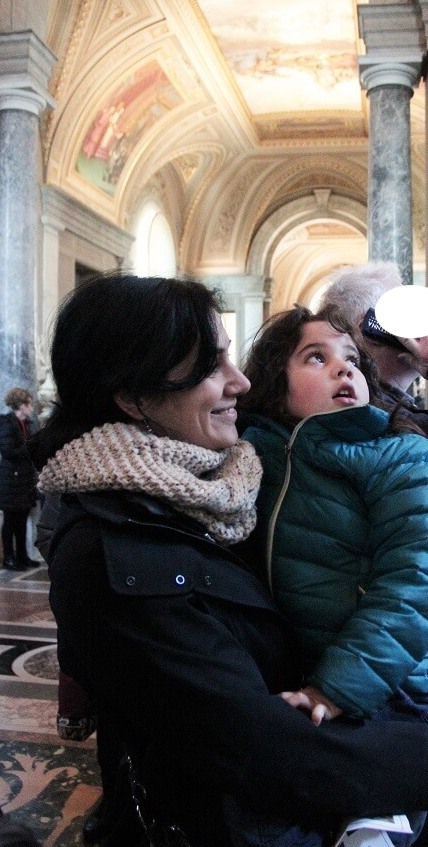
But with a good family tour, some advance planning and a few practical tricks, they can also be absolutely wonderful.
Our children have visited several times and they still talk about it: they talk about the Pope’s cars more than the art, but this is ok too!
The scale of the place alone, the sheer quantity of extraordinary things in every single room, tends to have an effect even on children who claim not to be interested in art.
My advice: don’t attempt this one without preparation. But do attempt it!
A note on 2026
2026 is an exceptionally busy year at the Vatican. Last year’s Jubilee kept many non-religious visitors away, and they are all arriving now. Crowds are very high.
My strong advice for this year:
- Book everything well in advance — tickets and tours do sell out especially those for kids since the good ones are only a handful
- Choose the earliest possible entry slot, or a before-opening tour if you can. The next best option is last entry
- Seriously consider a private or small-group family tour — an experienced guide who knows how to handle both crowds and children makes a huge difference
How to get tickets
The Vatican Museums are ticketed and booking in advance is not optional: it is essential as the line is genuinely hours long.
There are three ways I recommend for getting tickets without a tour:
Official Vatican Museums website — the cheapest option and the most reliable, click here. Book as far in advance as possible, especially for early-morning slots which sell out fastest. This is a great budget option: kids under 7 go free and kids 7 to 18 have a reduced rate. With a child ticket you can also add a kids’ audioguide, which is handy.
GetYourGuide — The next best thing. This is a third party site and is therefore a little pricier but it reliable and often has last-minute availability. Click here to see options.
ALL options are skip-the-line: the tickets are timed and you do not need to queue at the ticket desk, just beeline to the line marked ‘ticket holders’. You will need to queue for security but that is usually fast, you only need to get there about 15 mins before your entry time.
Good to know: they usually make strollers go first!
The best Vatican Museums tours for families
If there is one thing I would tell every family visiting the Vatican Museums, it is this: book a tour.
The difference between navigating these museums alone with children and navigating them with a brilliant guide who knows how to engage kids, knows which rooms to prioritise, knows how to avoid the worst of the crowds and knows how to make the Sistine Chapel genuinely meaningful — that difference is enormous.
I have done it both ways and there is no comparison. And I am not a tours person usually! I always visit places alone and since I know the Vatican Museums rather well, I also already know what to see and what to tell my kids. But even in my case, I found the tours absolutely invaluable!
These are the tours I trust and recommend:
Vatican Family Tour by LivTours — my top pick This is a private, scavenger-hunt-based family tour organised by one of my favourite tour providers in Italy. The guides are exceptional with children — fun, engaging, brilliant at keeping little ones involved — while still delivering a genuinely excellent tour for the adults. The game-based approach means children are active participants rather than reluctant followers, and it covers the museum highlights, the Sistine Chapel and the Egyptian Wing (fantastic! So many other tours skip it!). LivTours has special agreements with the Vatican which means their tickets are reliable even when booked well in advance — not something you can say about every operator. [CLICK HERE FOR PRICES AND BOOKINGS]
Alone in the Sistine Chapel (Keymaster / Turning on the Lights Tour) An exceptional, genuinely once-in-a-lifetime experience. You enter the museums and the Sistine Chapel before they open to the public, with only a tiny group of other visitors. The quiet, the space, the ability to actually look at the ceiling without being crushed — it is extraordinary. Not specifically a children’s tour, but the atmosphere makes it surprisingly accessible and magical even for kids. Very hard to get — book as early as possible. [CLICK HERE FOR INFO AND PRICES]

Early Morning Express Sistine Chapel Tour by LivTours This tour gets you into the museums before the official opening, with significantly fewer people in the galleries. It is not specifically a children’s tour, but the dramatically reduced crowds make it one of the best options for families — the biggest problem when visiting with kids is the volume of people, and this solves it. The early start is worth every minute and the compact duration makes it comprehensive but manageable for kids. [CLICK HERE FOR PRICE AND INFO]
Before your visit the Vatican Museums with kids: what to do at home
Decide what to see
The museums are vast and you will not be able to see everything, especially with children. Before you go, look at a map of the museum layout and decide which areas are your priority.
Rooms that tend to work particularly well with children include: the Carriage Pavilion (more on this below), the Map Gallery, the Gallery of Tapestries and the Greek and Roman sculpture galleries. The Egyptian Wing is also usually great for them.
The Sistine Chapel is at the very end of the standard route so you will not miss it regardless of what else you see.

Show them the Sistine Chapel ceiling before you go
Look up photos of the ceiling together and identify two or three elements to spot once you are inside. Keep them simple and large — the ceiling is very far away and tiny details are hard to make out. Having a specific thing to look for transforms the visit from passive to active for children – I find this to be true for parents itself just because the chapel has SO MUCH to see.
Prepare them for the rules
The Sistine Chapel has two rules that are strictly enforced and can catch children off guard: silence and no photography.
Preparing children in advance — explaining why these rules exist and what to expect — goes a long way, also with older kids who may have hoped to get a video of it.
At the Museums: tips that work
Head to the Carriage Pavilion first
Very close to the entrance is the Carriage Pavilion — and for many young children, this is the highlight of the entire visit.
It contains all the papal carriages and vehicles used over the centuries, from magnificent horse-drawn coaches to the various incarnations of the Popemobile.
It is usually less crowded than the main galleries, it is immediately engaging for children, and it sets a wonderful mood for the rest of the visit. Go here first.
Make it a treasure hunt
Even without a formal tour, you can easily create a simple scavenger hunt for your children.
Collect a few postcards of masterpieces you know are in the museums before your visit and challenge them to find the real thing or even just tell the kids to look out for animals: between statues, decorations and paintings, you have animals to be found in pretty much all rooms!
If all else fails, get them in charge of the navigation: red arrows are everywhere and help you find your way!
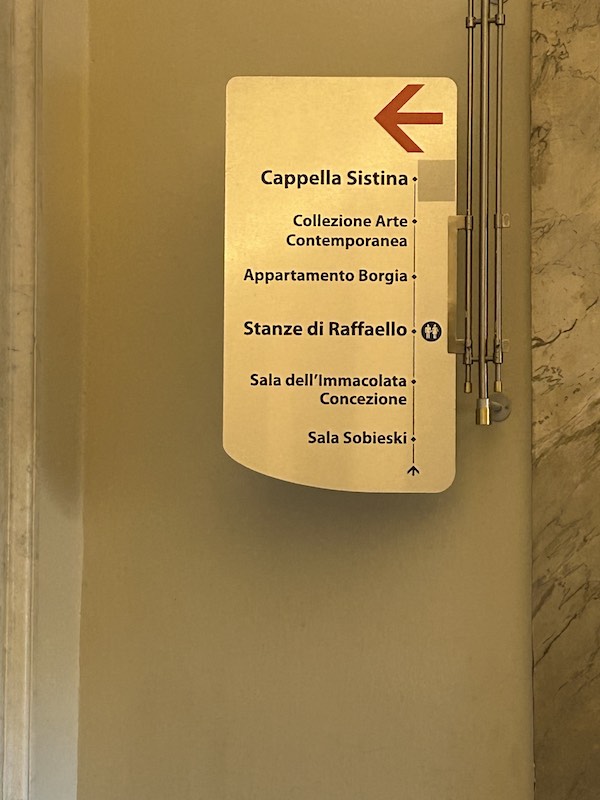
One of the really cool rooms you will pass on the way to the Sistine Chapel is the gallery of the maps.
Challenge them to find one with something they can recognise: a lake, a sea or maybe another destination in Italy you have already explored (Lake Garda is a nice one to spot, my kids love that map!)
Make the most of outdoor spaces
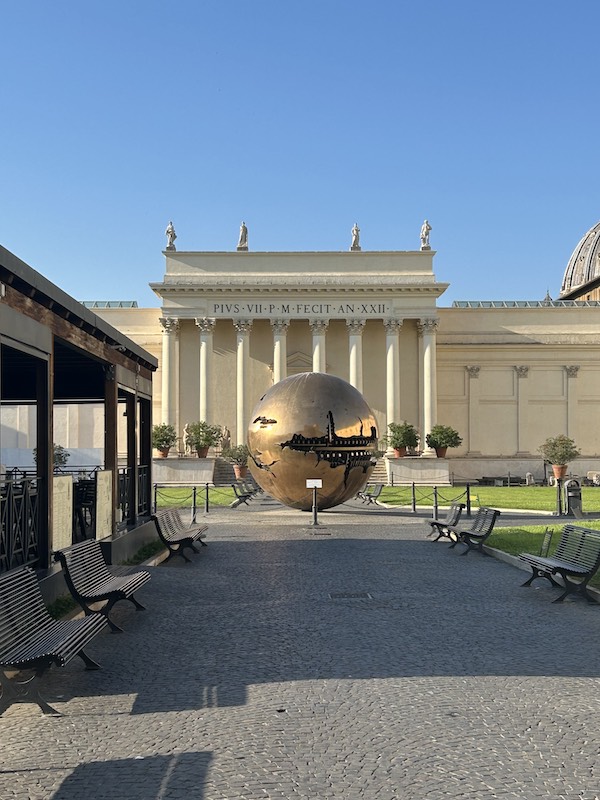
Every time you find yourself near an outdoor area, use it. Even in January, a few minutes of fresh air and open space does wonders for everyone — children and adults alike. The Vatican is beautiful everywhere, and the outside spaces make for wonderful photos too.
Eat before
You can bring kids’ snacks into the museums in your bag but as you can imagine, they cannot eat inside the museums themselves – crumbs and spillages are a fact of life with kids and they simply cannot happen here.
If you have a hangry kid, find one of the rest areas.
Consider booking lunch
The Vatican Museums have a café and a family-friendly restaurant inside (with a children’s menu) that are accessible to ticket holders only. For little visitors, there is a Self Service corner with kids’ menu and a Pizzeria, both equipped with high chairs.
Booking is essential. If you prefer to eat outside the museums, you can instead find here > my post about where to eat near the Vatican.
Stroller and accessibility rules
The good news is that the Vatican Museums do allow strollers and have accessible routes with lifts.
If you are following the standard visitor route, you will occasionally encounter steps where you will need to lift the pushchair – this is the reason why many tours say ‘no strollers’: they don’t want to wait for you as you manoeuvre the stairs.
If steps are not manageable, ask staff in each room to direct you to the nearest accessible path: I’ve always found them very nice and happy to help.

The less good news is that the museums are so crowded that navigating a stroller through the galleries is genuinely difficult.
You will repeatedly find yourself manoeuvring around other visitors and I genuinely am in two minds: on one hand the stroller helps, as there is a lot of walking to be done; on the other, it does mean your child has people towering over them all the time. For babies, I recommend a carrier instead. For toddlers there is no ideal option: I would suggest if bring both stroller and carrier and see how you feel in the moment.
Important: St Peter’s Basilica (separate from the museums) does not allow strollers inside. They can be left at the basilica cloakroom. Always check the stroller policy with your tour operator before you go: many state clearly they cannot wait for you to leave it at the cloackroom so it is paramount to have all the logistical info beforehand.
Visiting the Sistine Chapel with kids
The Sistine Chapel comes at the end of the museum visit and operates differently from the rest: visits happen in shifts, you enter with a group and leave with that group after an allocated time. It is the most rule-governed part of the visit and the one that benefits most from preparation.
Rules to know: silence is required and photography is not permitted. Both are enforced. Prepare children in advance so this is not a surprise.
Looking up together: once your children are settled, use the preparation you did at home. Point out the elements you identified together from photos. Let them find things themselves. Give them time to simply look. The chapel is extraordinary and children, given the space and the calm to actually experience it, often respond to it in ways that surprise you.
Dress code
The dress code applies throughout the museums as well as in the Sistine Chapel and basilica. It is strictly enforced and valid ticket holders are regularly refused entry for non-compliance. Even in the heat of summer: do not risk it.
Not permitted are: shorts above the knee, mini skirts, sleeveless or strapless tops, bare midriffs or backs, anything see-through, hats (in the chapel and basilica), large rucksacks. Also, they can refuse entry to anyone sporting writings, slogans or accessories deemed offensive to the Church.
Perfectly fine: normal t-shirts, capri pants, sandals, cross-body bags.
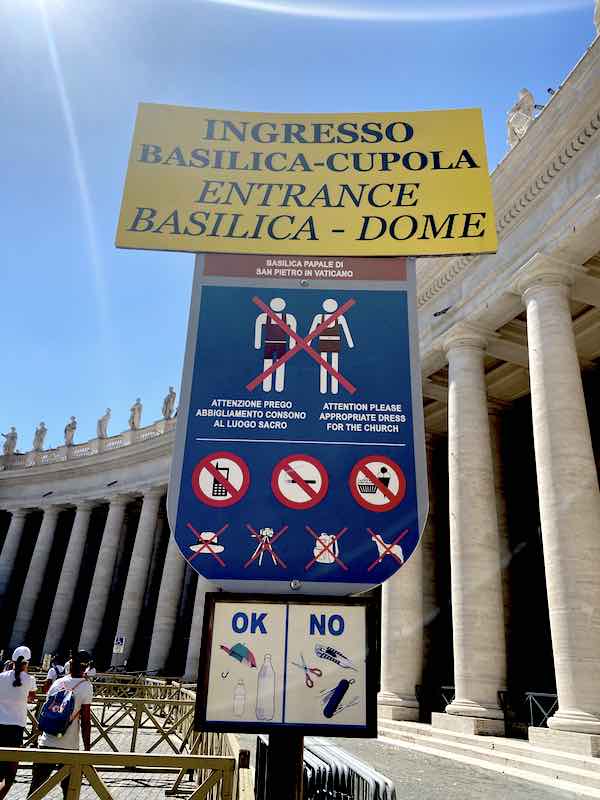
For younger children the code is slightly more relaxed: no one is going to consider a three year old ‘immodest’ for having bare legs, but always dress them in a way that is appropriate to a conservative religious setting. Pre-teens and teenagers must follow the same rules as adults.
I know this worries many especially for the summer but it is a good learning point for kids: no matter your comfort, some places demand a certain attire and it is consider disrespectful not to abide by it. They do NOT need to dress up: the rule is about decorum and modestly, they do not need their Sunday best.
You can find my full Vatican dress code guide here
How long do you need?
For a realistic visit and not a mad rush, factor in a minimum of 4 hours for the museums and Sistine Chapel. A full morning — arriving at opening or before — is better, and gives you time to move at a child’s pace without feeling rushed.
If you are combining the museums with the basilica and square, plan a full day and ideally split the two across separate visits. You will enjoy both far more.
I hope this guide helps you plan a wonderful visit to the Vatican Museums with your family. It is one of those experiences that, done well, stays with children for years — and with the right preparation, it absolutely can be done well. Buona visita (that’s happy visit in Italian!)